We live in a world that is all about convenience such that advances in technology have allowed immediate access to diverse foods, knowledge, social interactions, money, television shows and music without ever leaving the house. During drives, we often don’t hear children saying, “are we there yet” because of the constant distractions from iPads, iPhones and TV screens. Living in an ‘instant gratification’ world almost teaches us to despise waiting. However, waiting is a skill that children should be developing early on as it is the foundation for many other complex skills that require learning later in life. Learning to wait is a basic skill that increases patience, allows for the development of self-control and the regulation of emotions and behaviours. There are several simple and basic ways to teach children the art of waiting. Here are 5 ways that waiting can be taught to children without significant interruptions to daily life:
- Playing games: Both adults and children enjoy playing games and while these games may be seen as something fun to do, children also develop crucial skills such as waiting for a turn and learning to interact with else and learning to lose as well as that will help them succeed in life. Games that require turn-taking can support children in learning to wait are:

- Duck, Duck Goose
- Musical Chairs
- Hide and Seek
- Connect 4
- Uno
- Jigsaw Puzzles
- The waiting game – For example, when waiting for an appointment at the medical centre, ask your child to guess how long it will take before the GP comes out. Whoever guesses the closest wait time wins.
2. Saving Money towards a goal: Whether the goal is to buy the latest Lego blocks, buy a pair of shoes or go to an amusement park, putting money away for a goal, delays instant gratification, shows children the benefits of waiting and as a bonus, teaches your child about budgeting and finances!

3. Create waiting opportunities: Often when children want something, it is automatic for us to get up and fulfill that need. The next time your child asks for something (For example, a toy), ask them to wait a little while (2 minutes) and then give them the toy. This will create opportunities for your child to practice self-control and learn self-distraction skills while they are waiting. Note: this activity should not be done with food or water.
4. Use visual cues: Some children might have difficulty with understanding and telling the time. Therefore, having easy to understand visual cues such as a timer will help them in understanding the concept of time. There are apps on phones, computers and tablets that can be used to practice this. This can be done by either having the child wait for a tone when their waiting time has ended or wait for the “00.00.00”.
5. Use a reinforcer: This can be done by following the below steps:
|
Steps
|
Example
|
- Find a picture of an activity or item (e.g. a lollipop) your child is interested in and use it as a reward (reinforcer).
|
 |
|
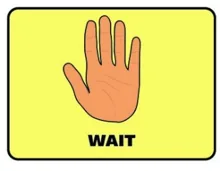
2. Show your child a wait icon and then show the reinforcer.
|
 |
|
3. Tell them that if they wait for a certain amount of time, they will receive this reward
|
“Timmy, if you wait 5 minutes with me then I will give you a lollipop.”
|
| 4. If they do this, provide positive praise and give them the reward
|
“Good waiting Timmy! Here is your lollipop”. |
| 5. Gradually extend the time of waiting for this will get the child to learn to wait long periods of time |
|
| 6. If your child is having trouble waiting, then try starting with a shorter waiting time until they can successfully wait. |
“Timmy, if you wait 1 minute with me then I will give you a lollypop”.
|