
Many parents will have difficulty trying to get their children to eat a range of different foods. Children will often have favourite foods and food preferences which can result in parents making a meal that is different from the rest of the family. Up to 50% of children will refuse to try 50% of new foods, so if your child doesn’t like trying new foods that is very normal!
It is important to stay positive and keep trying to get them to eat a range of foods! While most children experience some level of “picky” or “fussy” eating as part of childhood, it is important to know at what point parents need to seek professional advice.
Generally, picky eaters will be able to maintain an appropriate weight for their age.
Avoidant/Restrictive Food Intake Disorder (ARFID) may be diagnosed when a child is experiencing poor growth, low weight, nutritional deficits or social difficulties (not eating with others) as a result of “fussy eating” or food avoidance. This can develop because of sensory sensitivity or bad experience with eating such as choking or gagging.
Who can help?
If you have concerns about your child’s feeding, a team of professionals including a paediatrician, registered dietitian, speech pathologist and occupational therapist may need to be consulted. This is because there could be a range of different reasons or causes for the disorder.
If the reason is a sensory sensitivity, an Occupational Therapist may be able to assist in developing tolerance to different textures. Avoidance of foods may also occur due to delayed feeding skills and Speech Pathologist can assist in developing these skills.
When to seek help from a Speech Pathologist?
 It is recommended that a child have a swallowing assessment if:
- The child coughs during mealtimes.
- The child gags before or during mealtimes.
- The child has a gurgly voice after eating or drinking.
- The child has a long mealtime of over 30 minutes e.g. is still eating when all the other children have finished.
- The child is not gaining weight or growing.
- The child has difficulty keeping food or drink in their mouth when they are eating e.g. food or drink spills out of the child’s mouth when they are eating.
- The child drools a lot or has a liquid escape from their nose when eating and drinking.
When to seek help from an Occupational Therapist?
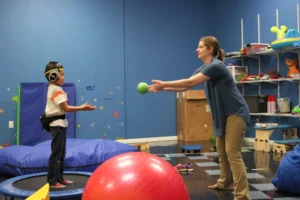 It is recommended that a child have a sensory feeding assessment if:
- The child refuses to eat a variety of foods and textures e.g. the child will only eat soft foods and refuses crunchy foods.
- If the child gags or becomes upset around certain smells.
- If the child has refused to eat due to the messiness of foods.
- If the child has difficulty sitting for long periods to eat.
- The child has a different meal and mealtime from the rest of the family.
- The child tries to avoid mealtimes or becomes upset around mealtimes e.g. it is difficult to get the child to sit at the table with the other children.
- You, as a teacher/parent, feel stressed around this child’s mealtimes.
- If the child has difficulty using cutlery.
- If the child has difficulty opening food packaging.
- If the child has difficulty getting food from their plate into their mouth.